 lawrence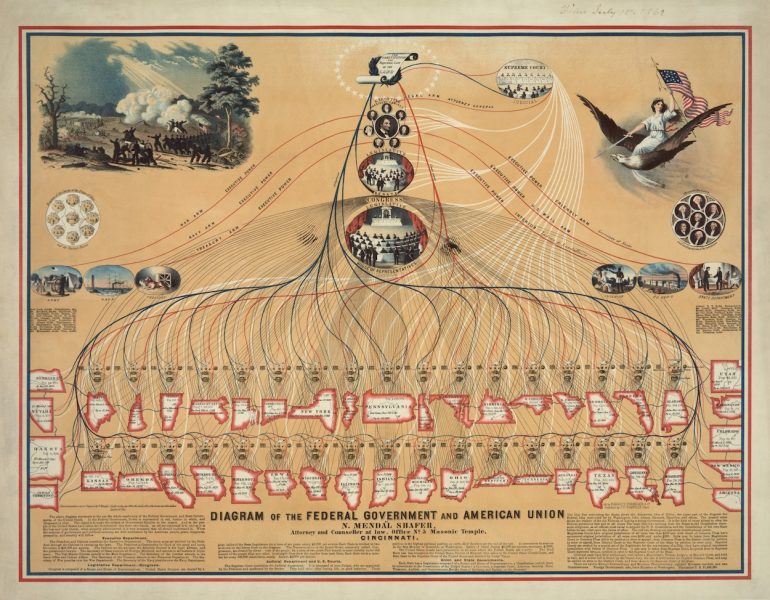
But what is government itself, but the greatest of all reflections on human nature? If men were angels, no government would be necessary. If angels were to govern men, neither external nor internal controls on government would be necessary. In framing a government which is to be administered by men over men, the great difficulty lies in this: you must first enable the government to control the governed; and in the next place oblige it to control itself.
Alexander Hamilton, The Federalist Paper No. 51
BIBLIOGRAPHY
- Shafer, N. Mendal. Diagram of the US Federal Government and American Union. 1862. lithography on paper. Library of Congress Prints and Photographs Division Washington, D.C..
- Hamilton, Alexander, or James Madison. Federalist No. 51: “The Structure of the Government Must Furnish the Proper Checks and Balances Between the Different Departments.” New York Packet, February 8, 1788. Print.
- Hobbes, Thomas. Leviathan, or, The Matter, Forme, & Power of a Commonwealth Ecclesiasticall and Civill. 1651.
- This is more than Consent, or Concord ; it is a reall Unitie of them all, in one and the same Person, made by Covenant of every man with every man, in such manner, as if every man should say to every man, / Authorise and give up my Right of Governing my selfe, to this Man, or to this Asse?nbly of men, on this condition, that thou give up thy Right to him, and Authorise all his Actions in like manner. This done, the Multitude so united in one Person, is called a Commonwealth, in latine Civitas. This is the Generation of that great Leviathan, or rather (to speake more reverently) of that Mortall God, to which wee owe under the Iimnortall God, our peace and defence. For by this Authoritie, given him by every particular man in the Commonwealth, he hath the use of so much Power and Strength conferred on him, that by terror thereof, he is inabled to conforme the wills of them all, to Peace at home and mutuall ayd against their enemies abroad. And in him consisteth the Essence of the Common-wealth ; which (to define it,) is One Person, of whose Acts a great Multitude by mutuall Covenants one with afiother, have made themselves every one the Author, to the end he may use the strength and means of them all, as he shall think expedient, for their Peace and Common Defence (Hobbes 131).
- Featherstonhaugh, G. W. The Republic of Cicero: Translated from the Latin; and Accompanied with a Critical and Historical Introduction. G. & C. CARVILL, 1829,
- “Already,” said Lælius, “I see the man I expected, so greatly endowed, and charged with such duties.” “With this duty only,” replied Africanus, “for in this one almost all the rest are included. That in his thoughts and actions he never deviate from himself, so that he may call upon others to imitate him, and that he may offer himself in the purity of his mind and his life, as a mirror to his fellow citizens. For as in stringed instruments or pipes, as well as in singing with voices, a certain harmony is to be formed with distinct sounds, an interruption to which cannot be borne by refined ears; this kindred and harmonious concert being produced by the modification of dissimilar voices. So a government temperately organized from the upper, the lower and middle orders blended together, harmonizes like music by the agreement of dissimilar sounds. And that which in song is called by musicians, harmony, is concord in a state; the strongest and best bond of safety in every republic; yet which without justice cannot be preserved (2.42).