 hanoi
hanoi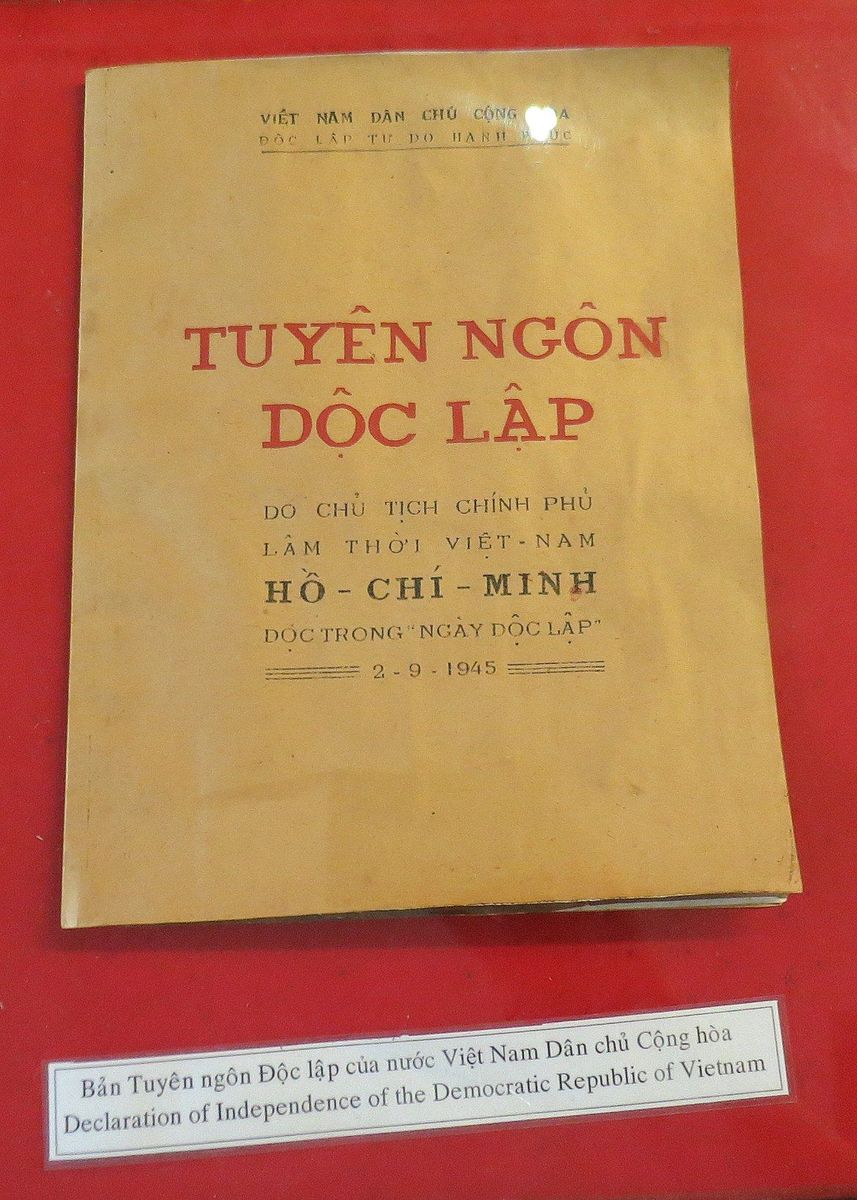
My country men,
“All men are created equal. They are endowed by their Creator with certain inalienable rights, among these are Life, Liberty, and the pursuit of Happiness”
This immortal statement was made in the Declaration of Independence of the United States of America in 1776. In a broader sense, this means: All the nations on the earth are equal from birth, all the nations have the right to live, to be happy and free.
The Declaration of the French Revolution made in 1791 on the Rights of Man and the Citizen also states: “All men are born free and with equal rights, and must always remain free and having equal rights.” Those are undeniable truths.
Nevertheless, for more than eighty years, the French colonialists misused the flag of Liberty, Equality, and Fraternity to invade our Fatherland and oppressed our country men. Their action contradicted to the humanity and justice. Politically, they absolutely have deprived our people of every democratic freedom.
Hồ Chí Minh, Declaration of Independence of the Democratic Republic of Vietnam
BIBLIOGRAPHY
- Hồ Chí Minh. Declaration of Independence of the Democratic Republic of Vietnam. 2 Sept. 1945. Government of the Socialist Republic of Vietnam, archived at Web Archive,
- Sartre, Jean‑Paul. “Preface.” The Wretched of the Earth, by Frantz Fanon, translated by Richard Philcox, Grove Press, 2004, pp. xliii–lxii.
- Not so long ago the Earth numbered 2 billion inhabitants, i.e., 500 million men and 1.5 billion “natives. ” The first possessed the Word, the others borrowed it. In between, an array of corrupt petty kings, feudal lords, and a fake, fabricated bourgeoisie served as go-betweens. In the colonies, truth displayed its nakedness; the metropolises preferred it clothed; they had to get the “natives” to love them. Like mothers, of sorts. The European elite decided to fabricate a native elite; they selected adolescents, branded the principles of Western culture on their foreheads with a red-hot iron, and gagged their mouths with sounds, pompous awkward words that twisted their tongues. After a short stay in the metropolis they were sent home, fully doctored. These walking lies had nothing more to say to their brothers; from Paris, London, and Amsterdam we yelled, “Parthenon! Fraternity!” and somewhere in Africa and Asia mouths echoed “ . . . thenon! . . . nity!” It was a golden age.
- Then it was over: the mouths opened of their own accord; the black and yellow voices still talked of our humanism, but it was to blame us for our inhumanity. We quite happily listened to these polite displays of bitterness. At first we were amazed and proud: “What? They can chat away all on their own? Look what we did with them!” There was no doubt in our minds they accepted our ideal since they were accusing us of not respecting it. Europe then really believed in its mission: it had Hellenized the Asians and created this new species, the Greco-Roman blacks. Pragmatic as ever, we added, quite among ourselves, “Oh let them shout, it will get it out of their system; their bark is worse than their bite (Satre xliii-xliv).”