 district of columbia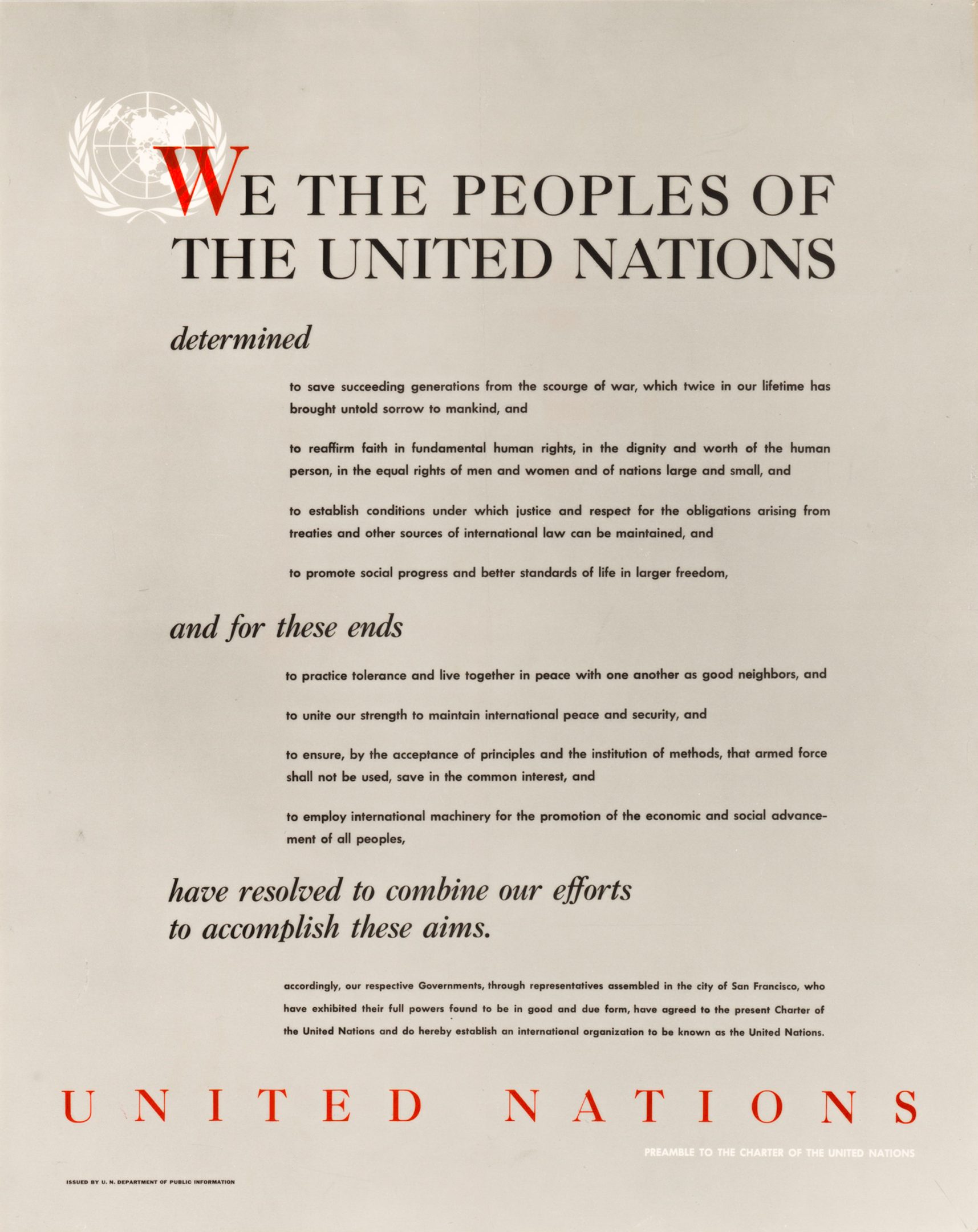
When the UN Charter speaks of “larger freedom,” it includes the basic political freedoms to which all human beings are entitled. But it also goes beyond them, encompassing what President Franklin Roosevelt called “freedom from want” and “freedom from fear.” Both our security and our principles have long demanded that we push forward all these frontiers of freedom, conscious that progress on one depends on and reinforces progress on the others.
Kofi Annan, ‘In Larger Freedom’: Decision Time at the UN
BIBLIOGRAPHY
- Annan, Kofi. “‘In Larger Freedom’: Decision Time at the UN.” Foreign Affairs, vol. 84, no. 3, 2005, pp. 63–74. JSTOR.
- When the UN Charter speaks of “larger freedom,” it includes the basic political freedoms to which all human beings are entitled. But it also goes beyond them, encompassing what President Franklin Roosevelt called “freedom from want” and “freedom from fear.” Both our security and our principles have long demanded that we push forward all these frontiers of freedom, conscious that progress on one depends on and reinforces progress on the others (Annan 64).
- Bush, George H. W. Toward a New World Order. Address Before a Joint Session of the Congress on the Persian Gulf Crisis and the Federal Budget Deficit, 11 Sept. 1990.
- Until now, the world we’ve known has been a world divided—a world of barbed wire and concrete block, conflict, and the cold war. Now, we can see a new world coming into view. A world in which there is the genuine prospect of new world order. In the words of Winston Churchill, a “world order” in which “the principles of justice and fair play … protect the weak against the strong …” A world where the United Nations, freed from cold war stalemate, is poised to fulfill the historic vision of its founders. A world in which freedom and respect for human rights find a home among all nations.
- Charter of the United Nations. 26 June 1945. First and signature pages. General Records of the United States Government, Record Group 11. National Archives, USA.
- Roosevelt, Franklin D. State of the Union Address to the Congress. 6 Jan. 1941.
- In the future days, which we seek to make secure, we look forward to a world founded upon four essential human freedoms. The first is freedom of speech, and expression—everywhere in the world. The second is freedom of every person to worship God in his own way—everywhere in the world. The third is freedom from want—which, translated into world terms, means economic understandings which will secure to every nation a healthy peacetime life for its inhabitants—everywhere in the world. The fourth is freedom from fear—which, translated into world terms, means a world-wide reduction of armaments to such a point and in such a thorough fashion that no nation will be in a position to commit an act of physical aggression against any neighbor—anywhere in the world. That is no vision of a distant millennium. It is a definite basis for a kind of world attainable in our own time and generation. That kind of world is the very antithesis of the so-called new order of tyranny which the dictators seek to create with the crash of a bomb.