 new york city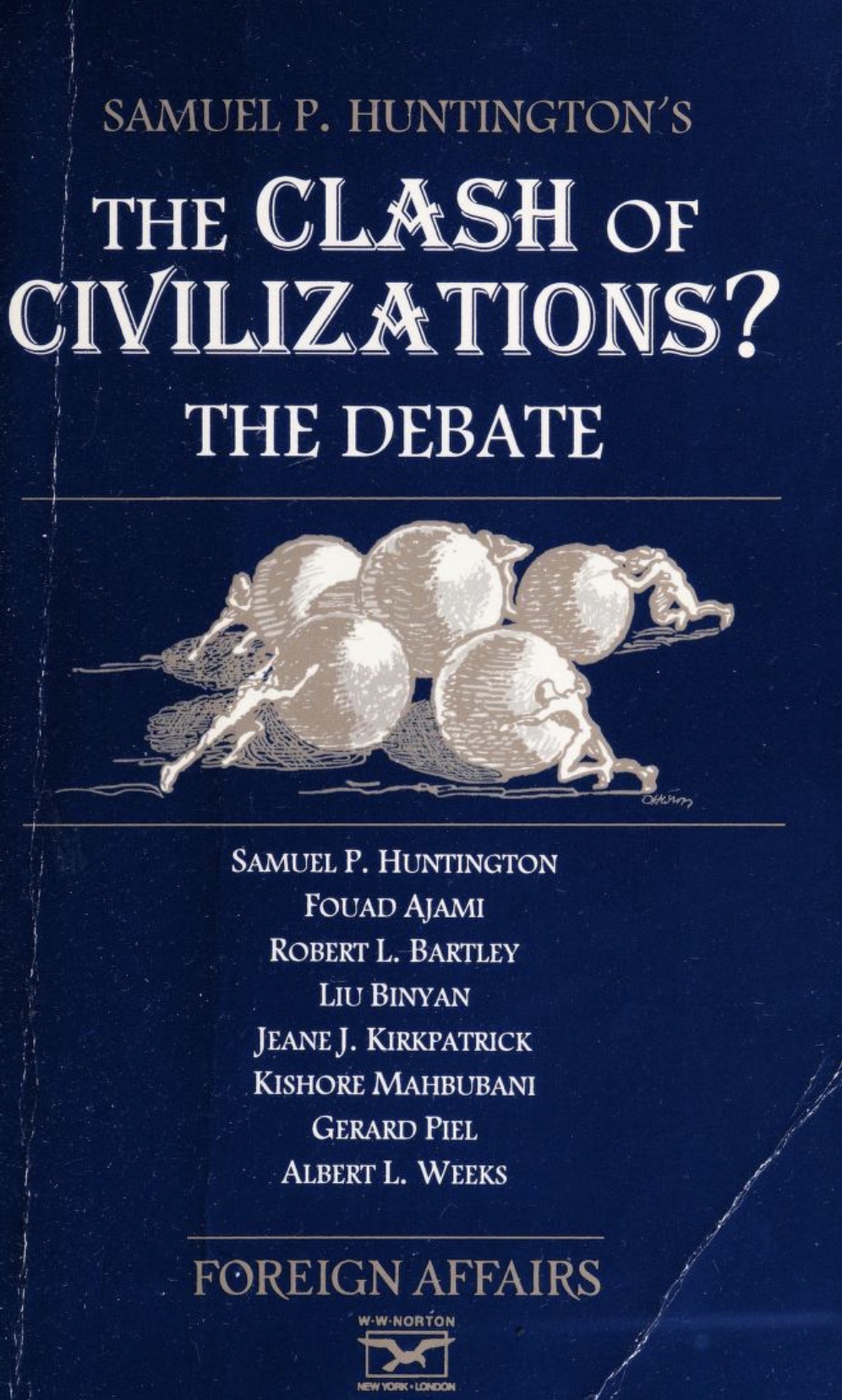
WORLD POLITICS is entering a new phase, and intellectuals have not hesitated to proliferate visions of what it will be—the end of his- tory, the return of traditional rivalries between nation states, and the decline of the nation state from the conflicting pulls of tribalism and globalism, among others. Each of these visions catches aspects of the emerging reality. Yet they all miss a crucial, indeed a central, aspect of what global politics is likely to be in the coming years. It is my hypothesis that the fundamental source of conflict in this new world will not be primarily ideological or primarily economic. The great divisions among humankind and the dominating source of conflict will be cultural. Nation states will remain the most powerful actors in world affairs, but the principal conflicts of global politics will occur between nations and groups of different civilizations. The clash of civilizations will dominate global politics. The fault lines between civilizations will be the battle lines of the future.
Samuel P. Huntingdon, The Clash of Civilizations?
BIBLIOGRAPHY
- Huntington, Samuel P. “The Clash of Civilizations?” Foreign Affairs, vol. 72, no. 3, Summer 1993, pp. 22–49.
- Satia, Priya. Time’s Monster: How History Makes History. Belknap Press of Harvard University Press, 2020.
- Historians will continue to expose the hypocrisies of imperialism, but here I want to show how certain intellectual resources, especially a certain kind of historical sensibility, allowed and continue to allow many people to avoid perceiving their ethically inconsistent actions—their hypocrisy—in the modern period. Culture, in the form of particular imaginaries of time and change, shaped the practical unfolding of empire. This is a book about how the historical discipline helped make empire—by making it ethically thinkable—and how empire made and remade the historical discipline. We are looking at how the culture around narrating history shaped the way people participated in the making of history—that area of rich overlap created by the two meanings of “history”: what happened, and the narrative of what happened. Essentializing representations of other places and peoples laid the cultural foundation of empire, but historical thinking empowered Britons to act on them. The cultural hold of a certain understanding of history and historical agency was not innocent but designedly complicit in the making of empire (Satia 6-7).
- Tolstoy, Leo Nikolayevich. War and Peace. Translated by Richard Pevear and Larissa Volokhonsky, New York: Vintage Books, 2007. Print.
- Wherever a moving ship may be heading, at its bow will always be seen the swirl of the wave it cuts through. For people on the ship, the movement of that swirl will be the only noticeable movement. Only by following closely, moment by moment, the movement of that swirl and comparing that movement with the movement of the ship, will we realize that at every moment the movement of the swirl is determined by the movement of the ship, and that we were misled by the fact that we ourselves were imperceptibly moving. We will see the same thing if we follow moment by moment the movement of historical figures (that is, having restored the necessary condition of all that happens—the condition of the continuity of movement in time) and do not lose sight of the necessary connection of historical figures with the masses. When a ship goes in one direction, there is one and the same swirl at its bow; when it frequently changes direction, the swirl running ahead of it also shifts frequently. But wherever it turns, there will always be a swirl preceding its movement (Tolstoy 1837).