 jornada del muerto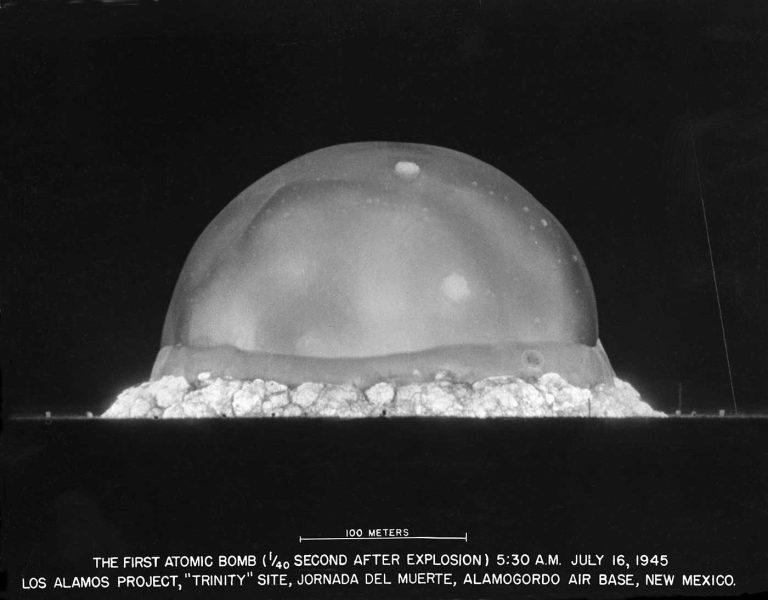
We knew the world would not be the same. A few people laughed, a few people cried, most people were silent. I remembered the line from the Hindu scripture, the Bhagavad-Gita. Vishnu is trying to persuade the Prince that he should do his duty and to impress him takes on his multi-armed form and says, “Now, I am become Death, the destroyer of worlds.” I suppose we all thought that one way or another.
Julius Robert Oppenheimer, The Decision to Drop the Bomb
BIBLIOGRAPHY
- “Trinity Bomb Test: 1/40 of a Second After Detonation.” Special Collections & Archives Research Center, Oregon State University Libraries, item no. 1446.
- “The Decision to Drop the Bomb.” Produced by Fred Freed. NBC White Paper. NBCUniversal. NBC, 5 January 1965. Television.
- Guénon, René. The Crisis of the Modern World. Translated by Marco Pallis, Sophia Perennis, 2001.
- The Hindu doctrine teaches that a human cycle, to which it gives the name of Manvantara, is divided into four periods marking so many stages during which the primordial spirituality becomes gradually more and more obscured , these are the same periods that the ancient traditions of the West called the Golden, Silver, Bronze and Iron Ages. We are now in the fourth age, the Kali-Yuga or “ dark age,” and have been so already, it is said, for more than six thousand years, that is to say since an epoch far earlier than any known to “ classical ” history. Since that time, the truths which were formerly within reach of all men have become more and more hidden and inaccessible ; those who possess them grow gradually less and less numerous, and although the treasure of “ non-human ” wisdom that was before the ages can never be lost, it becomes enveloped in ever more impenetrable veils, which hide it from men’s sight and make it extremely difficult to discover (Guenon 10).
- Rabbi Chaim Vital. Sefer Etz Chaim. Sefaria Community Translation.
- These ten circles (Igulim) of Adam Kadmon fill the entire vacated space within the midst of the Infinite Light, as explained earlier. They encompass the whole of that space, though a central point within them remains empty—left as room for the subsequent emanations, which are also arranged in circular form. These are the lights that flow from the “eyes” of Adam Kadmon—that is, from its linear form (yosher), the “image of Man.” These constitute the World of Nekudim, which also has circular formations, one within another, all standing within the ten circles of Adam Kadmon. Thus, the ten circles of Adam Kadmon encompass and surround all the other circles of all worlds. The higher and purer a circle is, the more it encompasses; the lower it is, the more inward it lies. The innermost of all is the lowest of all—the material firmaments and spheres of the World of Asiyah (Action), the ten celestial spheres mentioned in the introduction to the Tikkunim. These are called Ofanim (“wheels”), the firmaments that revolve above us in the physical world (Sefer Etz Chaim 2:2:13-14).
- Plato. Plato in Twelve Volumes, Vol. 9. Translated by Harold N. Fowler, Harvard University Press, 1925.
- There the utmost toil and struggle await the soul. For those that are called immortal, when they reach the top, pass outside and take their place on the outer surface of the heaven, and when they have taken their stand, the revolution carries them round and they behold the things outside of the heaven. But the region above the heaven was never worthily sung by any earthly poet, nor will it ever be. It is, however, as I shall tell; for I must dare to speak the truth, especially as truth is my theme. For the colorless, formless, and intangible truly existing essence, with which all true knowledge is concerned, holds this region and is visible only to the mind, the pilot of the soul. Now the divine intelligence, since it is nurtured on mind and pure knowledge, and the intelligence of every soul which is capable of receiving that which befits it, rejoices in seeing reality for a space of time and by gazing upon truth is nourished and made happy until the revolution brings it again to the same place (Phaedrus 247b).
- Sri Aurobindo. The Bhagavad Gita and Its Message. Translated by Sri Aurobindo and Anil Baran Roy, Lotus Light Publications, 1995.
- There we find the timeless being which is not illumined by sun or moon or fire (but is itself the light of the presence of the eternal Purusha); having gone thither they return not; that is the highest eternal status of My Being (The Bhagavad Gita 15.6).