 new delhi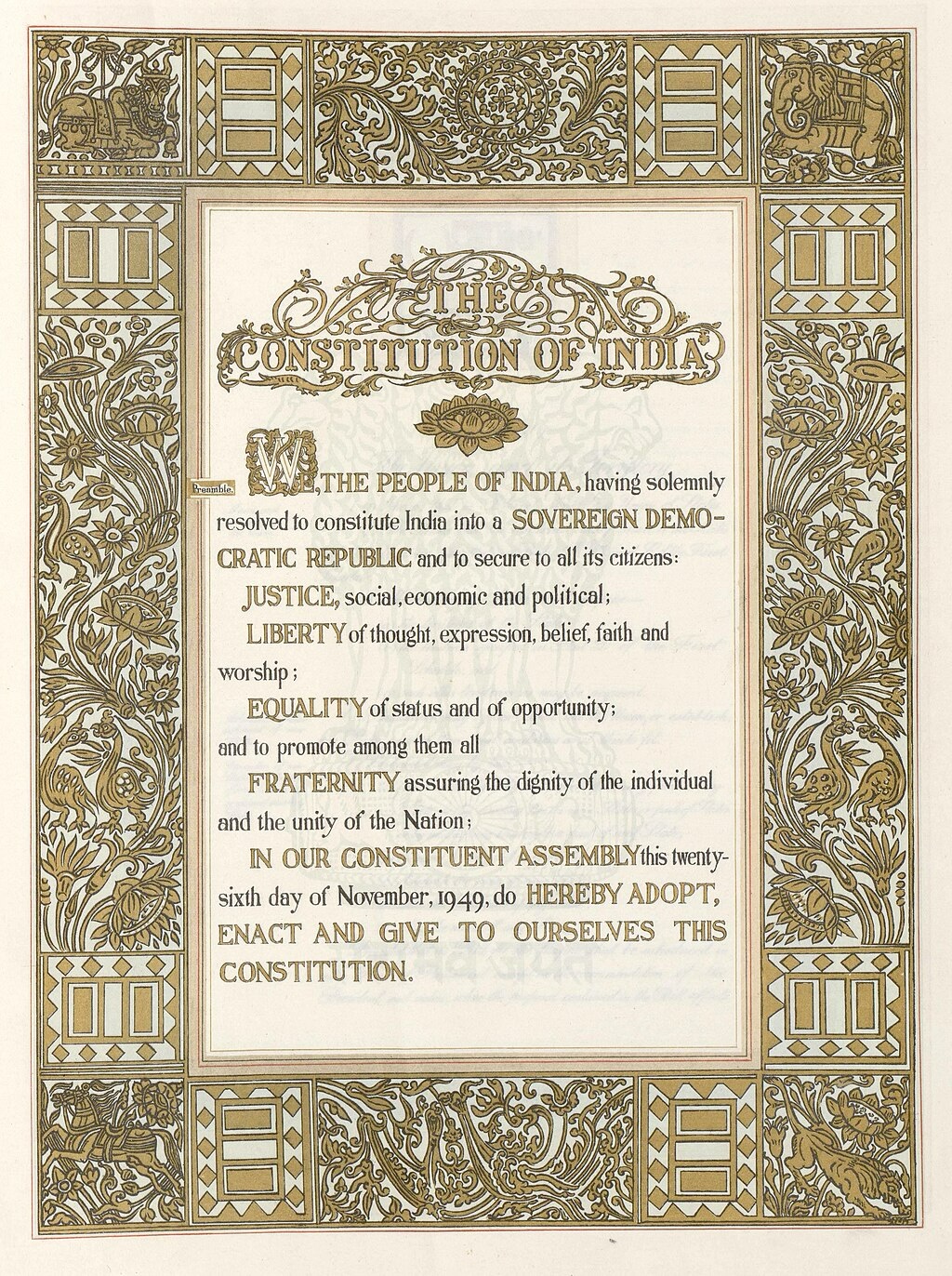
It was, indeed, a way of life, which recognizes liberty, equality, and fraternity as the principles of life and which cannot be divorced from each other: Liberty cannot be divorced from equality; equality cannot be divorced from liberty. Nor can liberty and equality be divorced from fraternity. Without equality, liberty would produce the supremacy of the few over the many. Equality without liberty would kill individual initiative. Without fraternity, liberty and equality could become a natural course of things.
Bhimrao Ramji Ambedkar, Speech to Constituent Assembly —1949
The Constitution of India begins with “WE, THE PEOPLE OF“—repeating the preamble of The Constitution of the United States. This repetition, however, is preceded by a host of differences that express themselves in INDIA. The preamble demarcating between WE, THE PEOPLE and INDIA. The linking preposition OF relating INDIA is more than a geography, in so far as it concerns THE PEOPLE, and more accurately a ground of being.
If the word INDIA is taken as a proper name: “a word that answers the purpose of showing what thing it is that we are talking about but not of telling anything about it (Mills 36),” then INDIA refers in the broadest sense to a body politic.
If as a corollary, the word Indian is taken as a proper adjective: “an adjective, typically capitalized, derived from a proper noun,” then this still leaves unanswered what does it mean to be Indian. Because if the proper adjective depends from a proper noun: “a noun that designates a particular being or thing,” then the proper adjective cannot convey more than what the proper adjective inherits from the proper noun. The proper adjective can only convey a beginning in the “thing it is.” The relationship between the proper adjective and the proper noun suggesting each Indian constitutes an India unto themself. So whereas initially, the word India defines the word Indian, the word Indian reflects back on the word India, and redefines the word India to comprise the sum of all Indians. There are in this sense as many Indias as there are Indians.
Reconciling the many connotations of the words India—past and present, leads to the word India refers to a history that precedes दाशराज्ञ युद्ध, dāśarājñá yuddhá: “The Battle of the Ten Kings” and succeeds The Discovery of India. Where India, the “thing it is,” begins is impossible to determine. Because India, like the eponymous river, has many beginnings and none—India, that is Bharat is a thing-in-process.
BIBLIOGRAPHY
- Ambedkar, B. R. “Speech to Constituent Assembly, 25 November 1949.” Constituent Assembly Debates, vol. 13, Constituent Assembly Secretariat / Government of India, 1950.
- Nehru, Jawaharlal. “Epilogue.” The Discovery of India. India, Meridian Books, 1946, pp 646-650.
- For she [India] is part of them in her greatness as well as her failings, and they are mirrored in those deep eyes of hers that have seen so much of life’s passion and joy and folly, and looked down into wisdom’s well (Nehru 646-647).
- “proper adjective.” Merriam-Webster’s Collegiate Dictionary, Eleventh Edition, Merriam-Webster Incorporated, 2004, p. 996.
- “proper noun.” Merriam-Webster’s Collegiate Dictionary, Eleventh Edition, Merriam-Webster Incorporated, 2004, p. 996.
- Sri Swami Sivananda. “Samanvaya Adhyaya.” Brahma Sutras vol. 1, The Sivananda Publication League, 1949, pp. 15-82.
- [Brahman is that] from which the origin etc., [i.e. the origin, sustenance and dissolution] of this [world proceed](Sri Swami Sivananda 18).